Community Events
The farmers markets around Brandon, a local guide
A market morning is the easiest community event to love: free to enter, over in two hours, and it ends with something good for dinner.
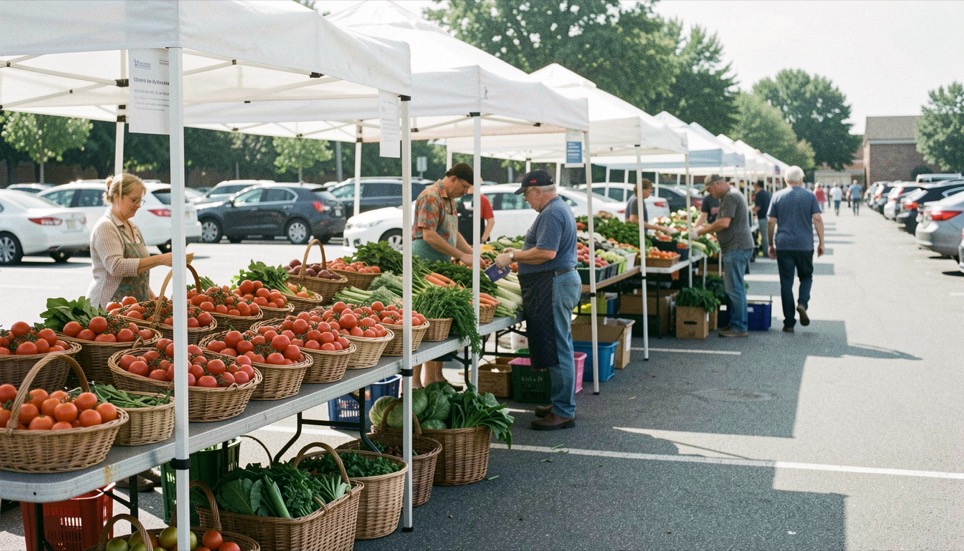
The farmers market is the best introduction to community life around Brandon. It requires no membership, no ticket and no commitment. You show up, you walk the stalls, you talk to the people who grew what you are buying, and you leave with a bag that makes the week feel more intentional. This guide explains how market mornings work here, what to expect from vendors, and how to build a routine around them.
What a market morning looks like
Markets in the Brandon area follow the Florida pattern: early setup, morning hours, done before the heat makes standing around a chore. The first hour belongs to the serious shoppers, the ones who know which grower has the best tomatoes and which baker sells out by nine. The last hour belongs to bargains, when vendors would rather sell produce than pack it back into a truck. Neither hour is wrong. Arrive early for choice, arrive late for deals, and arrive in the middle for the closest thing a suburb has to a town square.
What the stalls actually carry
Expect a consistent cast across the season. Produce comes in waves: greens and roots early, tomatoes and peppers as the heat arrives, tropical fruit through late summer, and a second gentle season as fall cools. Beyond produce, most markets around here carry honey, eggs, baked goods, jams, cut flowers and plant starts, plus a rotating fringe of prepared food and coffee. Plant starts deserve a special mention for Florida newcomers: local sellers stock varieties that survive our summers, which big-box garden sections routinely do not.
The same questions travel well. In central Maine, Belgrade Lakes Table covers a Sunday market in Belgrade Lakes village, the farm stands and winter outlets around it, and the creameries, sugar houses and apiaries that supply them. Its season runs mid-June to mid-September, shorter and sharper than Florida's, which makes the habit of asking where food was grown just as useful there. For readers curious how another region writes about its growers, the magazine is a calm example: third person, no sales pitch, dated facts kept dated.
What "local" means here has an honest answer, and it is worth asking directly where something was grown or made. Growers answer readily, because distance is the whole point of their pitch. A tomato picked at dawn forty minutes away is a different product from one bred for cross-country trucks, and tasting the two side by side is the fastest education a market offers. Price follows the same logic: market produce sits above supermarket loss leaders and below the specialty aisles, and the premium buys shelf life measured in days rather than weeks.
The unwritten rules
- Bring cash in small bills, even when some vendors take cards.
- Bring your own bags; the good bags fill up fast.
- Cooler in the car in summer, because Florida heat does not forgive a slow drive home.
- Ask before photographing a stall; vendors are friendly, not exhibits.
- Talk to growers about what is coming next week; it is the best shopping tip available.
Turning a market into a routine
| Habit | Why it works |
|---|---|
| Same market, same morning | A standing appointment survives; a spontaneous one does not |
| Cash in small bills | The fastest lines and the friendliest prices at the end of a market |
| Cooler in the trunk, May to September | Florida heat does not forgive a slow drive home |
| One errand paired nearby | The market anchors the route; the route earns its gas |
The households that get the most from markets treat them as a standing appointment rather than an outing. Pick one market and one morning, keep the route short, and pair it with something nearby: a park loop, a library stop, a breakfast place within walking distance. Market days also anchor the week for cooking, since whatever you buy shapes the next few dinners. If you are building family routines around town, the market pairs naturally with the ideas in our weekend plans for Brandon families.
Markets as community events
It is easy to miss that a market is a community institution, not just a shop. The same vendors return weekly, regulars recognize each other, and the market is where local groups set up folding tables to announce fundraisers, scout seasons and food drives. If you are looking for a doorway into local life, the market is the lowest-pressure one: buy some peaches, read every flyer pinned to the community board, and you will know more about the town than a month of scrolling. The community calendar guide explains where market mornings fit in the month, and the guide to joining local groups covers what to do with the flyers you pick up.
Season shapes the crowd as much as the stalls. Spring brings the best selection and the biggest crowds. Summer thins the stalls to the heat-hardy growers, and the smart shift is to arrive at opening time. Fall brings a second wave of interest and the pumpkin-and-mum displays that mark the season, and even winter markets stay productive because this is Florida. Whenever you go, the same rule applies as for every outdoor plan in our seasonal calendar: check the sky before you check the list.
Common mistakes to avoid
Market mornings go wrong in predictable ways. Shopping hungry is the oldest one, because the pastries win and the produce loses. Arriving at ten in July is the second, since the pickings and the shade are both gone by then. Assuming cards are enough is the third: some vendors take them, but the best early stalls run on cash, and an ATM surcharge is a poor first purchase. The last is treating the market as a supermarket run; the point is the season's calendar, the same faces, and the good dinner the bag becomes.
None of that takes practice to unlearn, just one deliberate morning. Arrive early, carry small bills, ask one grower what will be good next week, and let the bag decide dinner. The habit compounds quietly, and it is the cheapest way to feel like a regular in your own town.