Around Brandon
Fishing the Niagara across the border: licences, zones and limits
The Niagara is two fisheries wearing one name. Which shore, which reach, which rulebook: the planning version of a cross-border river.
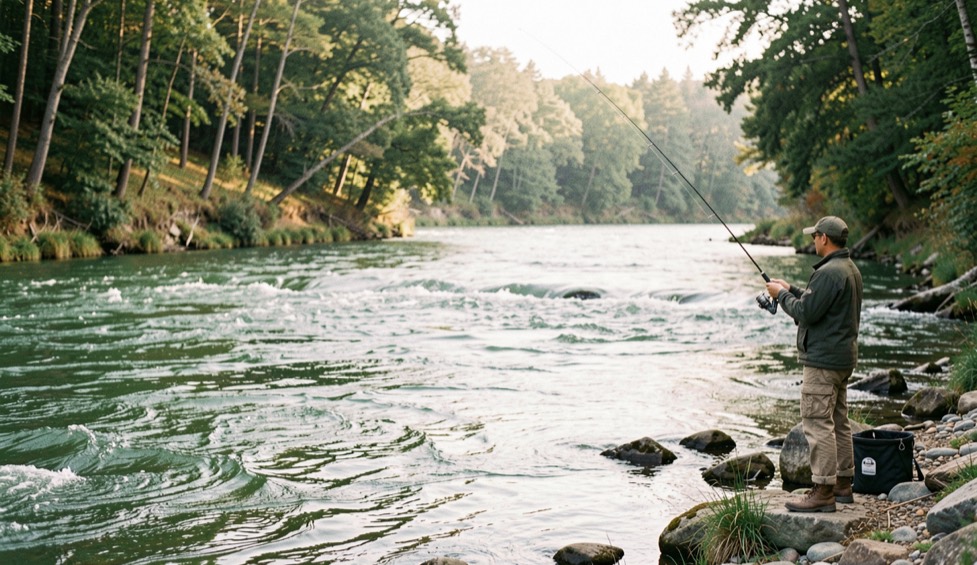
A Brandon family that drives north for a summer trip eventually reaches water that belongs to two countries at once. The Niagara River, running from Lake Erie to Lake Ontario past the falls, is one of those waters: celebrated fishing, two sets of rules, and a border down the middle of the current. The practical answer for anyone planning to fish it is simple. Decide which shore you will stand on, then read that shore's rulebook, because the licences, zones and limits are not the same on both banks. This note lays out the split before anyone buys the wrong licence.
The river itself is documented reach by reach in Current & Scale, a cross-border field guide to the Niagara's fish, seasons and angling rules, written for readers who plan a shore visit rather than a boat show. The planning version, the one a family needs before packing the rods, is below.
Two licences, two regulators
On the American shore the rules are New York's: a state fishing licence for anglers sixteen and older, and the Department of Environmental Conservation's freshwater regulations, published at dec.ny.gov, which divide the river into the upper Niagara above the falls and the lower Niagara below. On the Canadian shore the rules are Ontario's: a provincial licence, a different fee schedule, and the province's fisheries management zones, the river being split between FMZ 19 and FMZ 20 along its length. The province publishes its licence and zone framework at ontario.ca. Fishing from a boat near the line does not blend the two systems; the rule that applies is the one for the water you are actually on.
The reaches fish differently
The upper river, from Lake Erie down to the falls, is the shallower and calmer water: bass, walleye and panfish country, with well-known bass grounds near the head of the river. The lower river, from the falls through the gorge to Lake Ontario, is the cold-water side: deep, fast water where trout and salmon run on their own calendar. Season and species split along the same line, which is why a plan that says only "we will fish the Niagara" is not yet a plan; which Niagara comes first, and the tackle, the timing and the rules all follow that answer.
It also helps to name the species honestly. Smallmouth bass and walleye anchor the warm-water side, trout and salmon own the gorge runs, and each carries its own season table on each shore. A family that picks the fish before the date has the sequence backwards: the calendar decides what is legal before the map decides where to stand.
Shore access and family safety
A cross-border fishing day is also a family outing, and the access question deserves its own paragraph. Both shores publish their public access points, trails and observation areas, and the lower river's gorge trails are steep enough that the published guidance is worth reading rather than skimming. The marine forecast matters more than the air temperature: wind against the current is what turns a calm-looking reach into hard water, and both countries publish the marine outlook that decides it. For a family that fishes a little and wanders a lot, the shore parks and marked trails are the honest plan, with the rods as a bonus rather than the reason.
The crossing itself belongs in the plan too. Passports or the accepted border documents for every rider, a cooler rule about what food and bait can cross, and a realistic wait at the bridge on a summer weekend: none of it is difficult, but all of it is easier written down the night before than discovered at the booth.
Limits, sizes and bait
- Licence: a New York licence for United States water, an Ontario licence for Canadian water, each bought from its own system.
- Zone: the upper and lower reaches on the New York side, FMZ 19 and FMZ 20 on the Ontario side.
- Season: open and closed dates differ by species and by shore.
- Size: minimum lengths differ, and a legal fish on one bank can measure short on the other.
- Limits: possession is counted by the jurisdiction whose water produced the fish.
- Bait: baitfish rules differ too, and carrying live bait across the border has its own restrictions.
Planning a trip across the line
| Decision | What it settles |
|---|---|
| Which shore first? | Which licence to buy before anything else |
| Upper or lower river? | Warm-water species or cold-water species |
| Shore or boat? | Which access points and which jurisdiction's water |
| Keeping fish or releasing? | Which limits and size tables to carry |
| Bringing bait? | Border and bait rules on both sides |
The border mechanics deserve respect without drama. Recreational anglers cross this line constantly in season, and the system works because each side publishes its rules plainly. What fails trips is assumption: a licence bought for one shore, a limit remembered from the other, a bait bucket carried across a line it should not cross. The other half of the plan is the same one we use on the Alafia: check the marine forecast before the drive, since wind and current decide whether the gorge water is fishable at all.
Common mistakes to avoid
The errors are consistent. Fishing one shore's water with the other shore's licence is the first and the most expensive. Assuming the seasons match is the second; they often do not. Keeping a fish that is legal where caught but measured by the wrong shore's table is the third. Carrying live bait across the border is the fourth, a rule people learn at the ramp. And planning the day around the river's reputation instead of its reach is the fifth: the upper and lower Niagara are different fisheries wearing one name, and the family that picks the wrong one has a long drive to think about it.
Read this beside our own water habits and the pattern is familiar: the day trips guide treats every destination the same way, reach first and rules second, and the seasonal calendar is a reminder that every fish has a date attached before it has a place. Cross-border water only makes the habit easier to see.