Faith & Traditions
Community gatherings that hold Brandon together
The events that make a town are not the big ones. They are the potlucks, the bake sales and the standing committees nobody photographs.
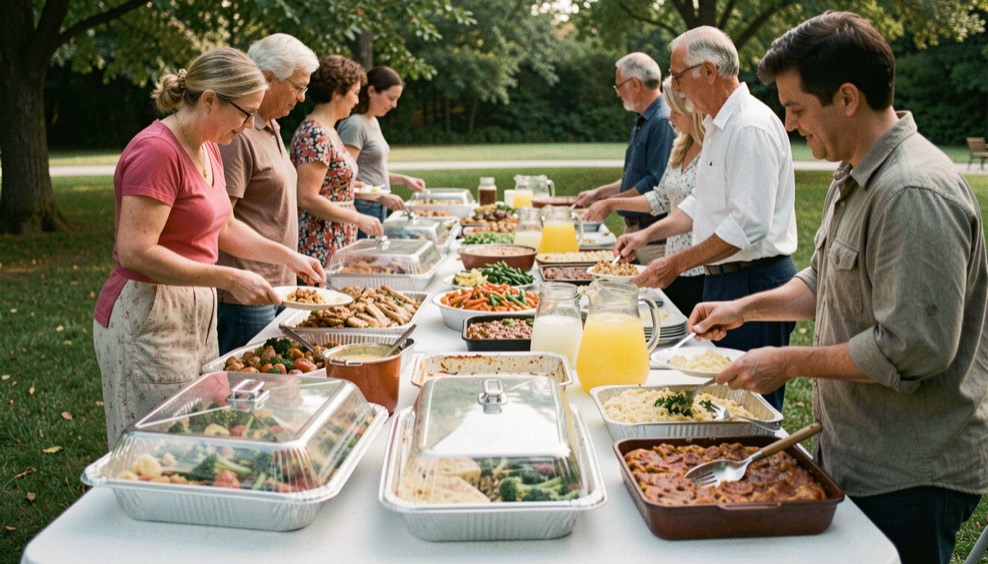
Ask what holds a community together and the honest answer is unglamorous: potlucks, committee meetings, concession stands, bake sales and the memorial bench with a name on it that someone repaints every year. Big events get the photographs. Small gatherings get the town. This guide is about the second category, the ordinary meetings where a place becomes a community one casserole at a time.
The potluck economy
The covered-dish dinner is the base unit of community life here, and it runs on an unwritten ledger. Someone coordinates, everyone brings one dish, and the event costs nobody very much while feeding everybody enough. Potlucks attach themselves to everything: club meetings, holiday gatherings, team celebrations, the end of volunteer seasons. If you attend one thing in a new town, make it a potluck, because eating at a folding table does more for belonging than a year of formal introductions. The craft circles in our hobby clubs guide are old hands at this format.
Fundraisers as social infrastructure
A small-town fundraiser is never really about the money alone; it is a public rehearsal of who cares. The bake sale, the car wash, the benefit walk, the spaghetti dinner that funds the same scholarship for two decades: these events announce needs, recruit volunteers and let everyone contribute at their own scale. The fall is the dense season, as our community calendar guide notes, but the circuit runs all year. Showing up to fundraisers, even just to buy the cake, is the lowest-effort form of civic participation available, and it is genuinely counted.
School nights and the parent calendar
For families, the school calendar is the community calendar. Spirit nights at local restaurants, book fairs, science expositions, concerts, field day, the award assemblies that run long and matter anyway: this is where parents of the same age meet repeatedly enough to become friends. The schools also anchor the volunteer economy, from reading buddies to field trip chaperones, which the volunteering guide covers in detail. A family that treats school events as gatherings rather than obligations usually ends the year with a social circle it did not plan.
Memorials, dedications and the long memory
Every established town keeps its memory in objects: the bench with a plaque, the tree planted for a teacher, the field named for a coach, the cornerstone on the building that half the town's childhood passed through. These are the gatherings that happened once and never stopped mattering. They are also why long-time residents react strongly to changes that newcomers find trivial; the trivial thing carries a name. Reading the plaques at parks, which our parks and neighborhoods tour makes easy, is the fastest history lesson a town offers.
Paperwork is its own kind of monument elsewhere; our guide to IDCO estates and allotments reads one state's version.
The gatherings worth saying yes to
- The potluck where you know nobody: highest social return per hour in local life.
- The fundraiser for a group you will never join: buying the cake is enough.
- The school performance of someone else's child: the applause is community work.
- The cleanup morning at the park you use: two hours, visible results, new acquaintances.
- The town's big shared days, starting with the one planned in the Fourth of July guide.
| Gathering | What it costs | What it builds |
|---|---|---|
| The potluck | One dish and thirty minutes | The strongest ties per hour in town |
| The fundraiser | The price of a cake | Proof you count, noticed by the people who run things |
| The school night | An evening a month | The parent circle that carries a decade |
| The cleanup morning | Two hours, old shoes | A park you helped keep, and new acquaintances |
Common mistakes to avoid
For someone new to town, the practical entry into this layer is the same as any other: watch the public listings, accept the open invitation, bring a dish when a dish is asked for. Almost every gathering described above has a public face, a flyer, a listing, a neighbor's mention, and the cultural rule is consistent: showing up is welcome, bringing something is appreciated, and nobody is expected to know the ritual in advance. The mistake newcomers make is waiting for a personal invitation that local custom simply does not require.
The other mistakes repeat across the gathering types. Arriving empty-handed to a potluck once is human; doing it twice is a reputation. Treating the fundraiser as a money event instead of a people event misses the point of being there. And photographing the memorial bench instead of sitting on it is the difference between collecting a town and joining one. The fixes are all small: one dish, one cake, one hour, and the camera in the pocket.
Big events create memories; small gatherings create relationships. A festival weekend gives a town something to talk about for a week, but a standing monthly potluck gives it a network that can organize anything, from food drives to memorial services, without starting from zero. When we described how to enter local life in the joining guide, the advice came down to this: find the small recurring thing and keep showing up. The town's whole capacity to care for itself is built out of folding tables, and there is always room for one more chair.